By Anatoliy Lisovskiy
The journey has been long and not always straightforward. But it has led me to the understanding I now consider correct: an amplifier should strive not to add anything noticeable of its own, but simply to convey the music. And finally I know how to do that — and I did it — gradually rejecting the beliefs and fashions of the audio industry.
In 1981, I graduated from the Tomsk Institute of Automated Control Systems and Radioelectronics (TIASUR). Like many engineers at that time, I was convinced that the path to high sound quality lay through measurable parameters: slew rate, low distortion, symmetry, and high power output.
Alongside my studies, I was actively involved in music — I played in the rock band “Allegro”. I had a small laboratory where I developed sound effects, amplifiers, an analog synthesizer, and a mixing console for the band. It was during this period that I began seriously experimenting with distortion. I didn’t just measure it — I created various types of musical distortion and listened to how they were perceived. This practical experience later proved extremely valuable, although at the time I didn’t yet understand its full significance.
As part of the official curriculum at the institute, we studied analog computers. Back then, I didn’t really understand why we were being taught what seemed like an outdated technology. Only much later did I realize how useful the knowledge of nested feedback loops and how they affect system behavior actually was.
I completed my diploma project at the microelectronics laboratory of TIASUR in cooperation with NIIPP. I developed a Doppler-effect radio-wave security device for premises. For this device, I designed a thick-film hybrid microcircuit. Even then, I was interested in compensating for technological variation — I specifically arranged and oriented the resistors on the substrate so that deviations in their resistance would compensate each other through the topology. The thick-film technology I worked with was, in essence, one of the predecessors of modern SMD technology.
After graduation, I built what I then considered the pinnacle of amplifier design: a powerful symmetrical amplifier based on the operational amplifier principle. Two hundred watts per channel, high slew rate, and low measured distortion. I sincerely believed there was nowhere further to go — that measurements and theory should guarantee the best possible sound.
The turning point came in 2002 in the United States. At the Stereo Unlimited store in Walnut Creek, California, I heard a triode amplifier driving Magnepan panels for the first time. My jaw literally dropped. It felt as though Diana Krall and her band were performing right there in the room. It wasn’t just “beautiful.” It was alive and natural — with a quality of decay and microdynamics I had never encountered before.
After that, a long search began. I first experimented with push-pull designs under the Pyramid project — versions with 6P3S tubes, then with GU-50 tubes using nested feedback. The sound was quite good, but I never felt fully satisfied. Over time, I came to the conclusion that maximum transparency and natural decay required a single-ended architecture.
This led to Gubernator-71 — a single-ended amplifier delivering 45 watts per channel. In essence, it became the prototype for the future Edelweiss-3: it already featured nested feedback loops and a 12-position switch for adjusting output impedance. However, Gubernator-71 proved too power-hungry and generated too much heat for practical use. For most loudspeakers with sensitivity around 93 dB, such power reserves were excessive.
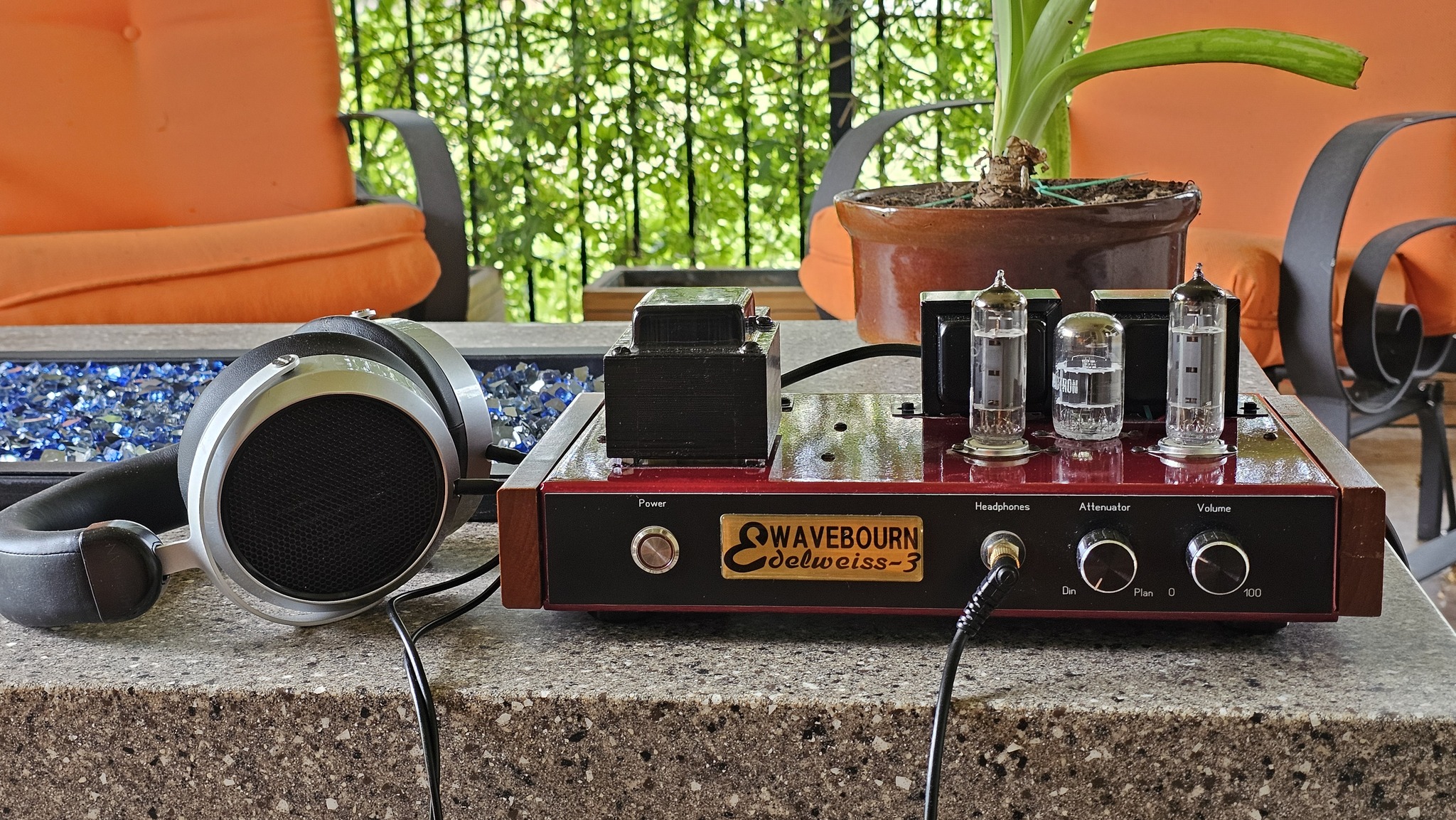
In 2019, I developed Edelweiss-3 — a single-ended amplifier using readily available tubes (EL34, KT88, and similar), with nested feedback loops and the ability to adjust output impedance. My main goal was no longer simply to reduce distortion levels, but to make the distortions behave in a specific way: to decay monotonically along with the useful signal and to narrow their spectrum. So that no noticeable “tail” of distortion would remain on decaying notes and in reverberation. The result is the purest tube sound due to the masking of inevitable distortions by the peculiarities of auditory perception, and the amplifier turned out to be omnivorous: for Diana Krall, for a symphony, or even for metal rock. Variable damping control defies the "Damping Factor" myth, as well as belief that for bass repropduction high power push-pull amplifiers are required.